
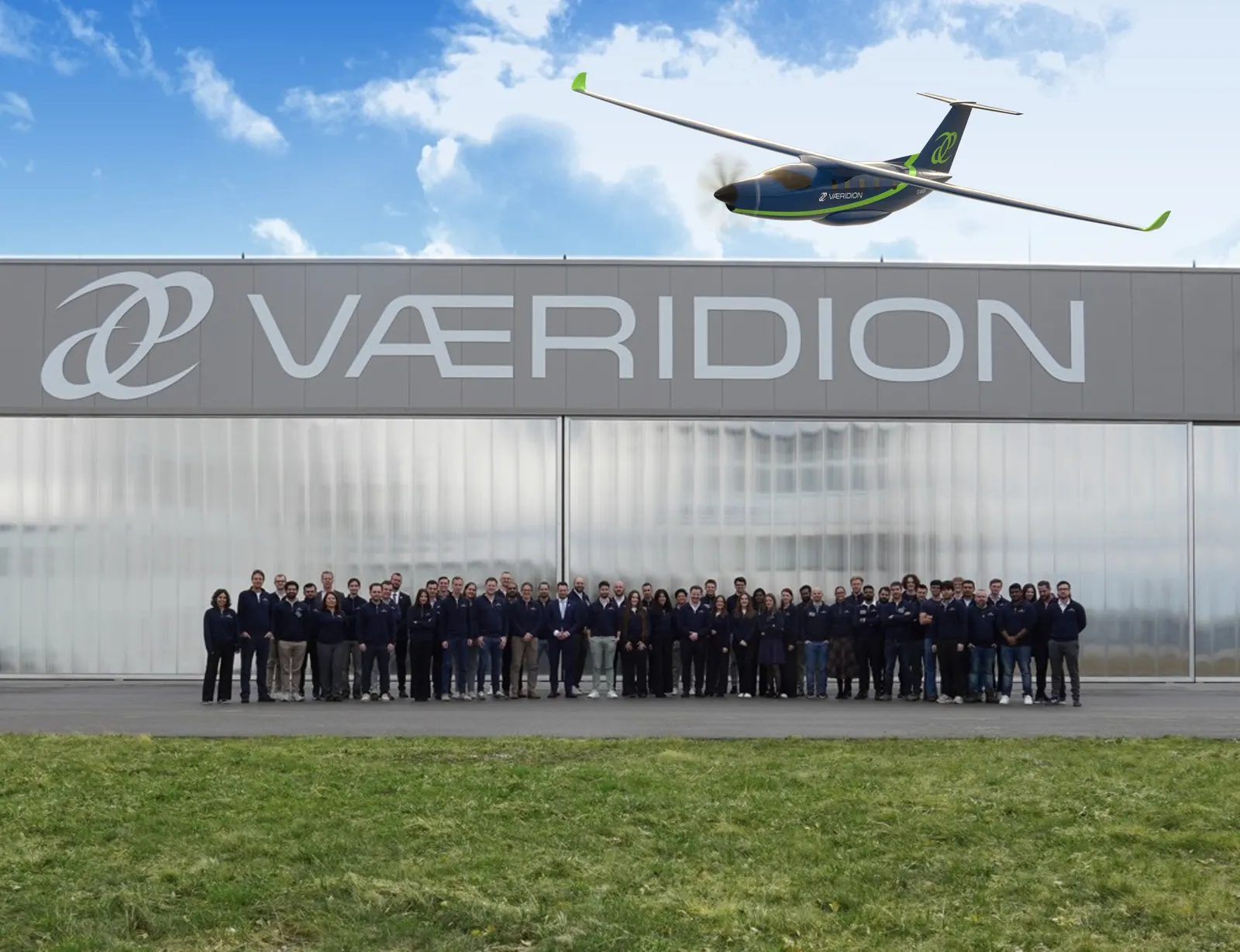
VÆRIDION has closed a €30 million funding round, led by SHIFT Invest and Invest-NL, to develop the Microliner, a nine-passenger, all-electric aircraft. In addition, the European Commission has selected VÆRIDION for a €94.5 million grant from the EU Innovation Fund. Together, this brings VÆRIDION's ambition of making affordable electric regional flying a reality a step closer.
Existing investors World Fund, Project A, Vsquared Ventures and InnovationQuarter also took part in the round, alongside several European family offices. The capital will fund the next steps in the Microliner’s development, including building the first conforming prototype for the certification programme and further testing of the battery and propulsion system. Including this round and earlier funding, VÆRIDION has raised approximately €60 million to date.
The grant was awarded to VÆRIDION’s CAROLUS project and is in addition to the equity raised. With it, the company aims to establish and ramp up a final assembly facility at Oberpfaffenhofen Airport near Munich. CAROLUS was selected from 358 applications as one of only 12 large-scale projects. Within that category, it is the only aviation project and the only German project. The selection remains subject to completion of the grant agreement, expected to be signed in 2027.
Why electric flight
Regional flying used to be far more common than it is today. High fuel and maintenance costs make short flights with today’s ageing turboprop aircraft increasingly unprofitable, as well as polluting. The Microliner is built to change these economics. An electric aircraft needs no kerosene and has fewer moving parts, which significantly reduces fuel and maintenance costs. This could bring fares down to the level of a first-class rail ticket, making regional flying profitable and sustainable again.
The opportunity extends beyond replacing existing aircraft. Demand for mobility keeps growing, and electric aircraft are quiet, zero-emission and energy-efficient. The Microliner can also use existing regional airfields, which typically have ample spare capacity, opening up opportunities for new direct regional connections. McKinsey estimates that the global market for regional air mobility could reach up to $115 billion by 2035.
The Microliner: from design to aircraft
The Microliner combines a glider-inspired wing with integrated batteries in a patented design. Two electric motors together drive a single propeller.
The aircraft is being developed for a range of 400 kilometres with nine passengers or 10 m³ of cargo. Its low noise could also open up new opportunities for flights from regional airports, subject to local approval.
Ivor van Dartel, Founder and CEO of VÆRIDION, said:
“Over the past year, we have turned the Microliner from a validated design into hardware. At our own facility in Oberpfaffenhofen, which we opened in March, we are now testing our propulsion and battery technology.
This funding round enables us to build our first conforming prototype for the certification programme. The Commission’s selection of CAROLUS supports the next step: producing the Microliner at scale. We are not just developing an electric aircraft. We are building a European aircraft manufacturer to make regional flying commercially viable and accessible again, in Europe and worldwide.”
A German company with Dutch roots
VÆRIDION’s headquarters and its test and production facility are in Bavaria, but a significant part of its research and development takes place in Delft, in close collaboration with the Faculty of Aerospace Engineering at TU Delft. The company has more than 75 employees. Founder and CEO Ivor van Dartel is Dutch and studied at TU Delft.
In Amsterdam-based SHIFT Invest, VÆRIDION gains a natural lead investor. With established aviation industry players and TU Delft among its investors, SHIFT knows the aviation sector from close up, and as an impact investor it is committed to a more sustainable future.
Invest-NL is a fund partner of SHIFT, and through this investment aims to contribute to an innovative, sustainable and resilient Netherlands.
Thijs Gitmans, General Partner at SHIFT Invest, said:
“Regional aviation is one of the clearest cases where electrification makes both commercial and environmental sense. VÆRIDION has chosen a clear certification pathway and has already delivered tangible results on a disciplined budget. We are proud to lead this round and to contribute to the development of electric flight as part of a European consortium.”
Next steps towards 2030
With this round, VÆRIDION takes a significant step towards bringing the Microliner into commercial service in 2030. The company has already reached important milestones on the road to certification: it has completed its Preliminary Design Review and signed a second Pre-Application Contract with the European Union Aviation Safety Agency (EASA). VÆRIDION has also secured commercial commitments for more than 130 aircraft, valued at more than €730 million, with ASL Group as launch customer, and works with established partners including Dassault Systèmes, GKN Aerospace, Molicel and MT-Propeller.
It is of strategic importance that Dutch investors are leading this round, together with a European consortium and with support from the European Commission. It shows that Europe can develop its own technology and become less dependent on expertise and energy from outside Europe. Above all, it brings electric regional flight a step closer.